Sell Your House and Downsize to a New Mobile Home
Turn Your Equity Into a Modern Mobile Home in Eau Claire
If you own a single-family house and have built up equity, you may be in a stronger financial position than you realize. But as your needs change, maintaining a larger house may no longer be the best use of your time, money, or space. Downsizing to a new mobile home at Hillcrest Estates in Altoona or Villa Diann in Eau Claire can provide a practical alternative.
Instead of continuing to pay for unused space, aging systems, expensive maintenance and expensive upgrades, you can sell your existing house and use the equity to purchase a smaller, modern, and efficient home. Depending on your equity and the home you choose, you may be able to purchase your next home with cash or combine your sale proceeds with financing. This guide explains the benefits of downsizing, how to use the equity from your current house, and the step-by-step process of moving into a new home at Hillcrest Estates or Villa Diann.
- Why Consider Downsizing?
- Put Your Home Equity to Work
- Scenarios
- Scenario 1: You Own Your Home Outright.
- Scenario 2: You Have Mortgage and Substantial Equity. You Buy a Mobile Home with Equity.
- Scenario 3: You Have Some Equity. Use Your Equity to Buy a Mobile Home and Finance the Rest
- What Do I Need to Know to Discuss My Options?
- The Downsizing Process
- See Whether Downsizing Works for You
Why Consider Downsizing?
The High Cost of Maintaining a Single-Family House
Owning a larger house comes with expenses beyond the mortgage. Roofs, siding, furnaces, air conditioners, plumbing, driveways, landscaping, snow removal, property taxes, insurance, and other maintenance expenses can add up. As a house gets older, major repairs and replacements can become more frequent. There is also the time involved. Mowing a large lawn, shoveling snow, cleaning rooms you rarely use, maintaining landscaping, and coordinating repairs all require attention. If you are using only part of your house, you may be paying to maintain much more home than you actually need.
For many homeowners, the house that made sense 10 or 20 years ago may not make sense today. Perhaps your children have moved out. Maybe you have bedrooms, a basement, or a large yard that you rarely use. Or you may simply be ready to spend less time and money taking care of a house.
Expensive Upgrades May Be Ahead
Older homes can also reach a point where substantial upgrades are needed. You may be looking at an aging kitchen, bathrooms that need remodeling, old flooring, windows that need replacement, or mechanical systems approaching the end of their useful lives. Before putting another $20,000, $50,000, or more into a house that is larger than you need, it may be worth asking a different question: Would that money be better used toward a newer, smaller home?
Put Your Home Equity to Work
One of the biggest advantages available to an existing homeowner is equity. Home equity is generally the difference between what your house is worth and what you still owe on it. For example, suppose you sell your current house for $300,000 and have a $100,000 mortgage payoff. Before selling costs and other adjustments, that leaves approximately $200,000 of gross equity. That money gives you options.
Rather than automatically putting all of it into another expensive single-family house, you could use a portion of your equity to purchase a mobile home and keep the remaining funds available for savings, retirement, investments, debt reduction, travel, or other priorities. The exact result depends on your current home's sale price, mortgage payoff, selling expenses, the price of your new home, and whether you choose to finance any portion of the purchase.
Scenarios
It’s always helpful to have some concrete examples. In the following sections, we show three different scenarios for a typical house in Chippewa Valley with a price of 300k. We will use a mobile home with price of $115,000 including sales tax. The scenarios differ by the amount of equity you have in your home. In the first scenario, you own your home outright and you can buy a mobile home with cash. In the second scenario, your mortgage balance is about half of the home value. In the third scenario, your mortgage balance is about two third of home value.
Scenario 1: You Own Your Home Outright.
You Buy a Mobile Home with Equity and Take Out Remaining Equity.
If you own your home outright, downsizing to a mobile home can help you take out the equity you have built over the years while downsizing to a more modern and efficient home. You can do this while maintaining affordable monthly payment.
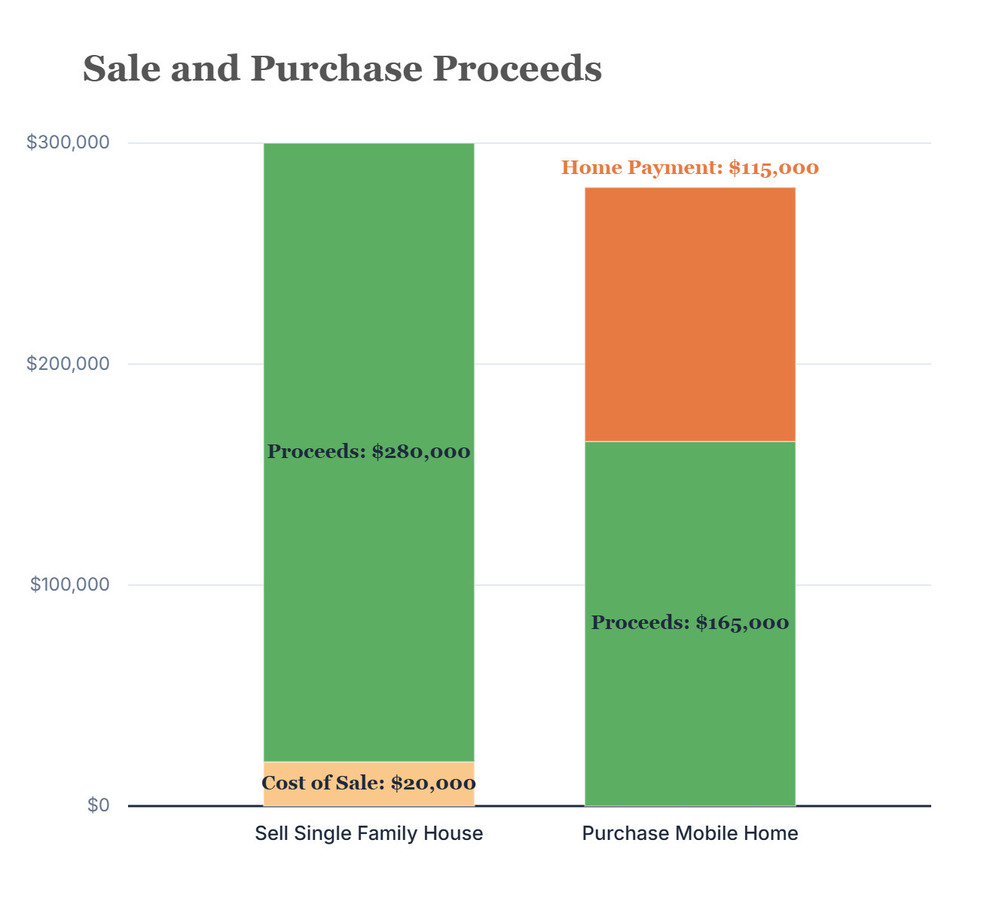
In this scenario, you sell your home and take about 280k in proceeds after the cost of sale is taken out. Then you purchase a mobile home for 115k. You will have 165k remaining after the purchase. You can use the funds in any way you choose. You can invest, take that , such as investing, taking a vacation, covering medical expenses, and helping children buy their own homes.
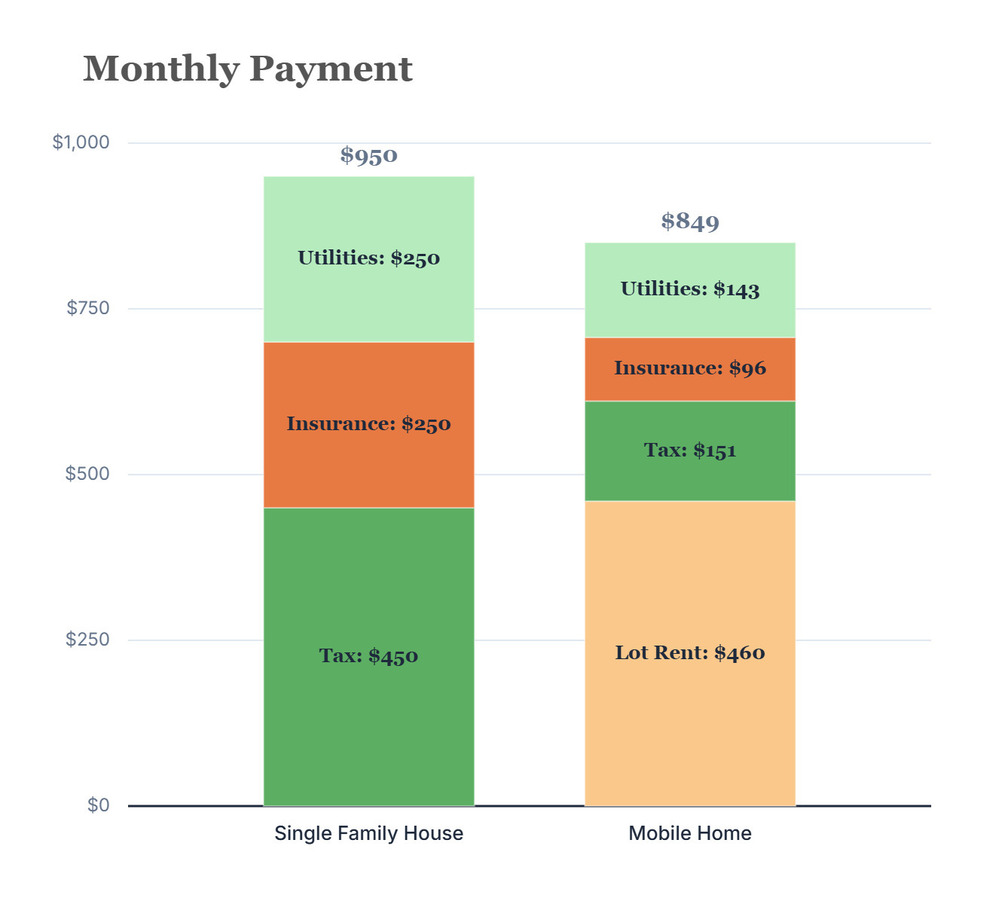
If you owned your home outright, your monthly housing payment was quite reasonable. When you purchase a mobile home, the payment will continue to be affordable. In this scenario, you pay about $950/month in utilities, insurance, and taxes for the single family house. The monthly payment for a mobile home is about $850. While new housing costs will include lot rent, there are substantial savings in utilities, insurance and tax.
Scenario 2: You Have Mortgage and Substantial Equity. You Buy a Mobile Home with Equity.
For homeowners with substantial equity, the simplest option may be to sell the existing house and purchase the new mobile home with cash.
For example, imagine your home is worth 300k and your mortgage balance is $150k. After paying off your mortgage and selling expenses, you receive $130k from your sale. You purchase a mobile home at $115,000 with cash. Now you don’t have a loan on your home. Additionally you can take home the remaining equity of 15k.
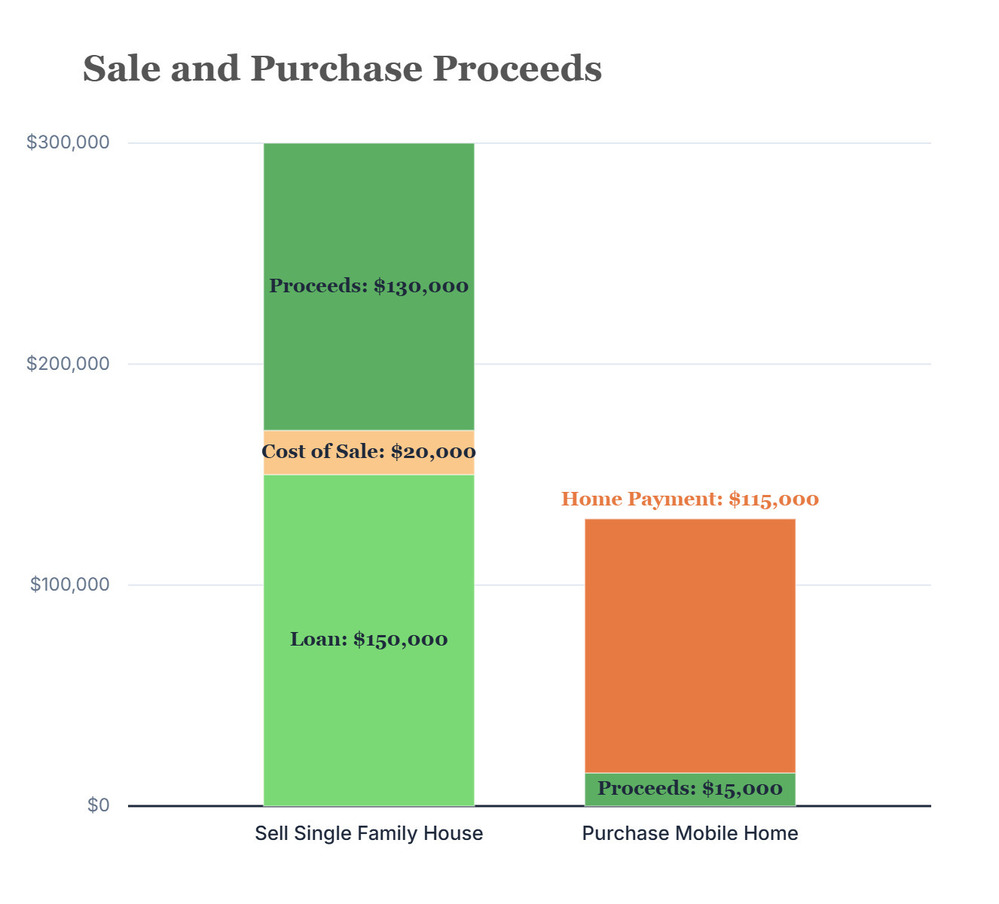
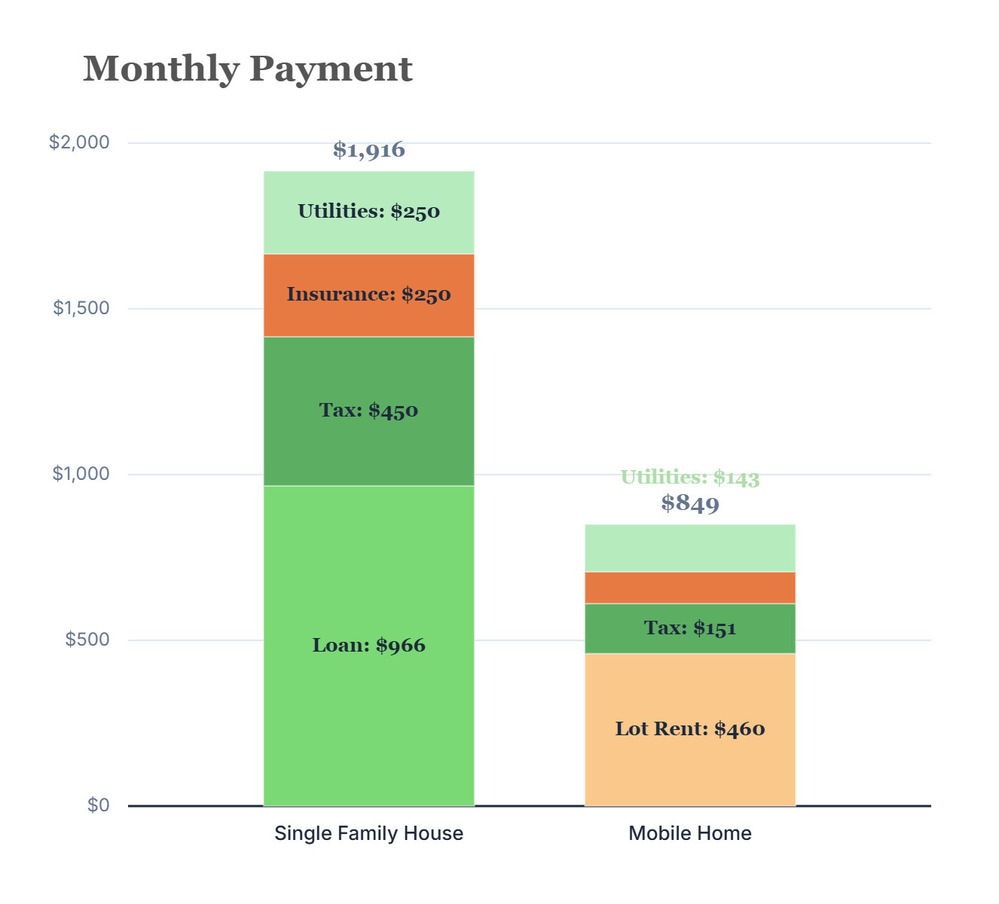
This dramatically changes your monthly housing expenses. You would still have ongoing expenses such as lot rent, utilities, insurance, and other applicable costs, but you would not have a monthly home-loan payment. Your monthly housing payment decreases from $1900 to $850. Your monthly housing cost is cut in half!
For someone approaching retirement or simply looking to reduce monthly expenses, this can be an attractive use of existing home equity.
Scenario 3: You Have Some Equity. Use Your Equity to Buy a Mobile Home and Finance the Rest
You do not necessarily need enough equity to pay for the entire mobile home.
Another option is to use part of the proceeds from your existing house as a substantial down payment and finance the remaining purchase price
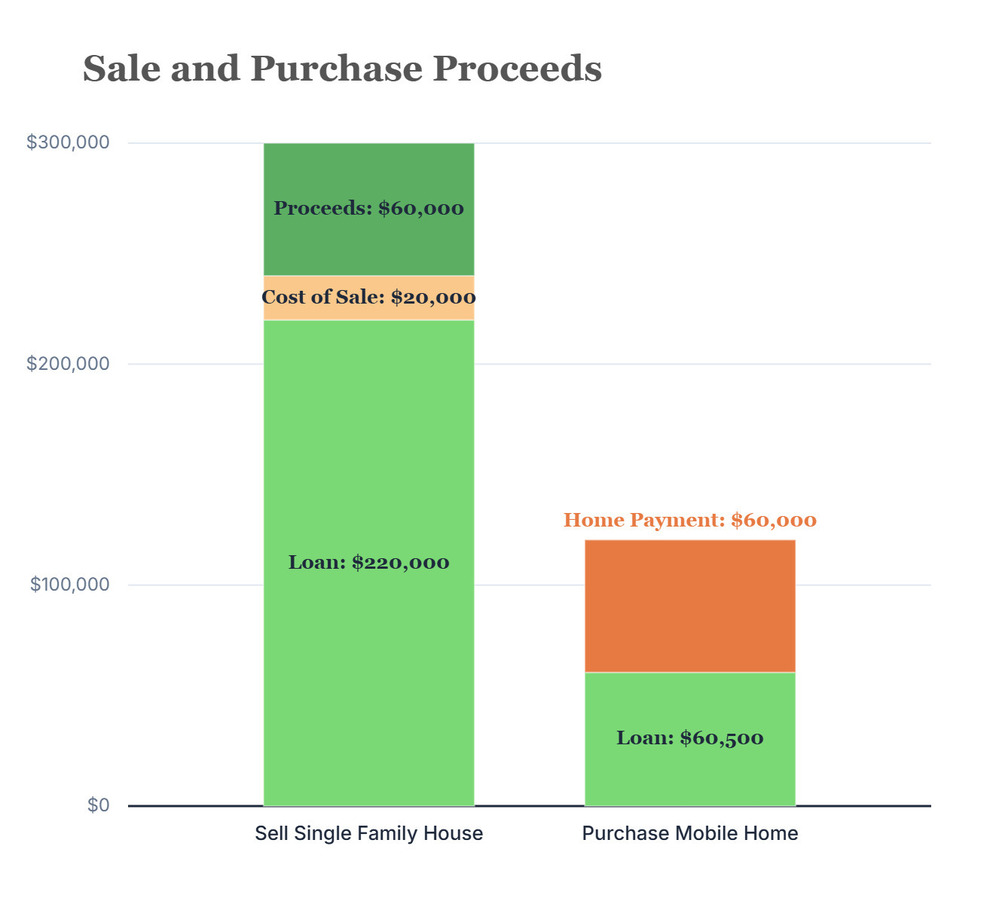
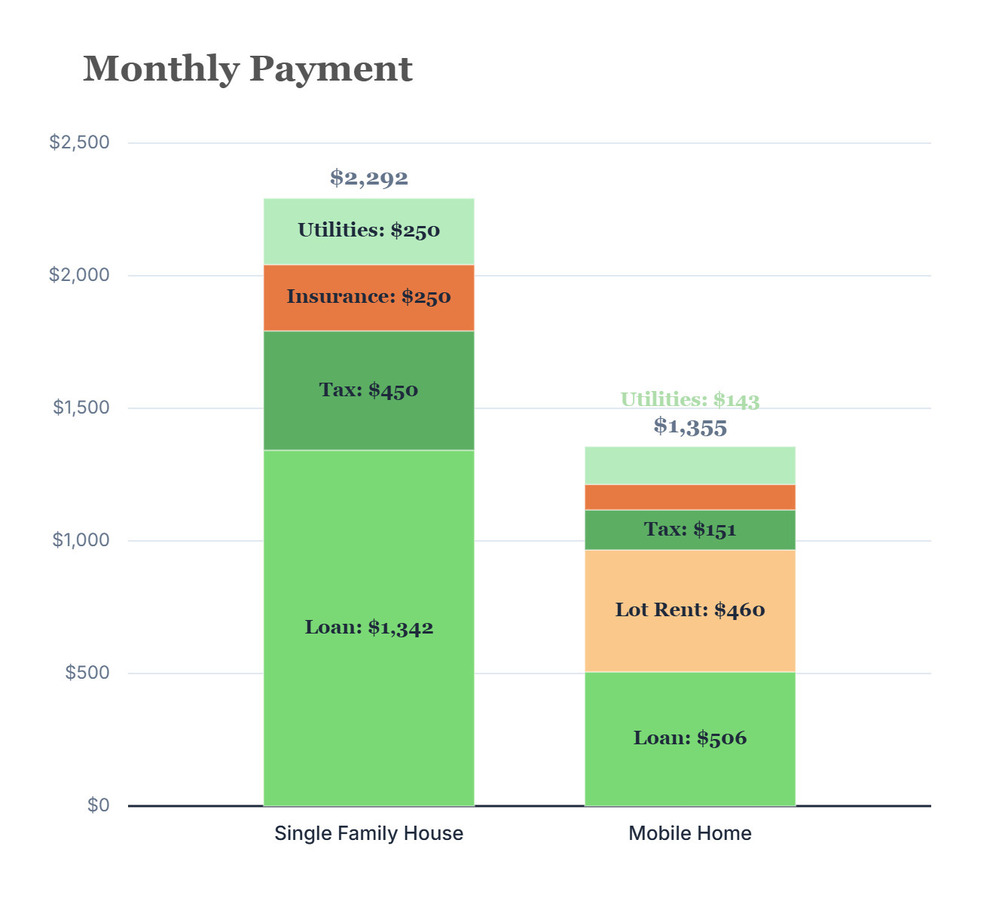
In this scenario, you sell your home and get proceed for $60,000. You put the 60k (50%) down for a new mobile home and take out a 60k loan. Now you have significantly reduced your home loan balance from 220k to 60k. Subsequently, your monthly housing payment decreases from $2,292 to $1,355. That is substantial savings every month.
What Do I Need to Know to Discuss My Options?
Do you want to know what your numbers would look like? We can create a scenario with your current home and an available mobile home in our communities.
You do not have to sell your house before you start exploring your options. In fact, it can be helpful to begin the conversation earlier.
Start by gathering a few basic numbers:
- Current home address: This helps establish what property you may be selling.
- Estimated home value: A real estate professional can help you determine a reasonable potential selling price.
- Mortgage payoff: Contact your mortgage company to determine approximately how much remains on your loan.
- Estimated equity: Subtract your mortgage payoff and anticipated selling costs from the expected sale proceeds to get a better picture of the money you may have available.
- New home price: Identify the Hillcrest Estates or Villa Diann home that fits your needs and budget.
- Once you have these numbers, you can provide detailed estimates like the scenarios shown above.
The Downsizing Process
Moving from a long-time house can seem complicated, particularly when the purchase of your next home depends on selling your current one. Breaking the process into steps makes it much more manageable.
1. Gather Information on Your Home
Start by gathering information about your home mentioned above: estimated home value, mortgage payoff, estimated equity, and ideal timeline for downsizing.
2. Check Out the Homes
Start by looking at available homes at Hillcrest Estates and Villa Diann.
Consider the number of bedrooms and bathrooms you actually need, the layout, storage, location, monthly costs, and how the home would work for you over the next several years.
You do not need to make a commitment just to take a tour.
3. Start the Conversation
Tell us about your situation.
If financing may be needed, your approximate credit situation, income, available down payment, and existing debts can help determine the next steps.
The purpose of this conversation is to understand whether downsizing is financially practical before you make major decisions.
4. Determine Your Selling and Closing Timeline
Determine when your house can be listed, approximately how long a sale may take, when you expect to receive your sale proceeds, and when you would like to move.
From there, the purchase and sale can be planned around a realistic timeline.
5. Sign the Purchase Agreement
Once you have selected your home and are ready to proceed, the next step is the purchase agreement.
The Wisconsin Manufactured Home Purchase Contract identifies the home, purchase price, down payment, amount due at closing, community placement, closing arrangements, and whether the transaction is cash or subject to financing. If financing is part of the transaction, the contract can identify financing terms and a deadline for obtaining confirmation.
Because the purchase agreement becomes binding when accepted, buyers should carefully review the entire contract, schedules, financing conditions, cancellation provisions, and other terms before signing.
5. Complete Financing, If Needed
If you are financing part of the purchase, complete the lender's application and provide the requested documentation.
The lender will evaluate factors such as credit, income, debts, down payment, and the amount you want to borrow.
If you are paying cash from the sale of your existing home, financing may not be necessary.
6. Close on Your New Home
At closing, the remaining purchase funds are paid and the required purchase and ownership documents are completed.
The purchase contract provides for a specified closing date and distinguishes between cash and financed transactions.
Your particular timeline should be coordinated carefully if the money for your purchase is coming from the closing of your existing house.
7. Move Into Your New Home
Once the transactions are complete and the home is ready for occupancy, you can make the move.
Downsizing is also a good opportunity to decide what you actually want to bring with you. Furniture, household items, tools, and belongings accumulated over many years do not all need to follow you into your next home.
The result can be more than a smaller house. It can be a simpler way of living.
A Different Way to Think About Your Home Equity
If you have owned your house for many years, you may have spent decades building equity. The next question is what you want that equity to do for you.You could put nearly all of it into another single-family house.Or you could potentially use a smaller portion to purchase a modern mobile home, reduce your monthly housing obligations, and preserve more of your money for other priorities.
For homeowners with substantial equity and more house than they need, downsizing to Eau Claire or Altoona deserves serious consideration.
See Whether Downsizing Works for You
You do not have to decide today whether to sell your house. Start by looking at the numbers and touring a home.
Bring us four basic pieces of information: your current home's approximate value, mortgage payoff, and whether you expect to pay cash or need financing. If financing is needed, we can also discuss your approximate credit, income, debts, and available down payment. Then you can compare your options and decide whether downsizing makes sense.
- Hillcrest Estates – Altoona, Wisconsin
- Villa Diann – Eau Claire, Wisconsin
Ready to explore downsizing? Schedule a home tour and start the conversation with our team.